
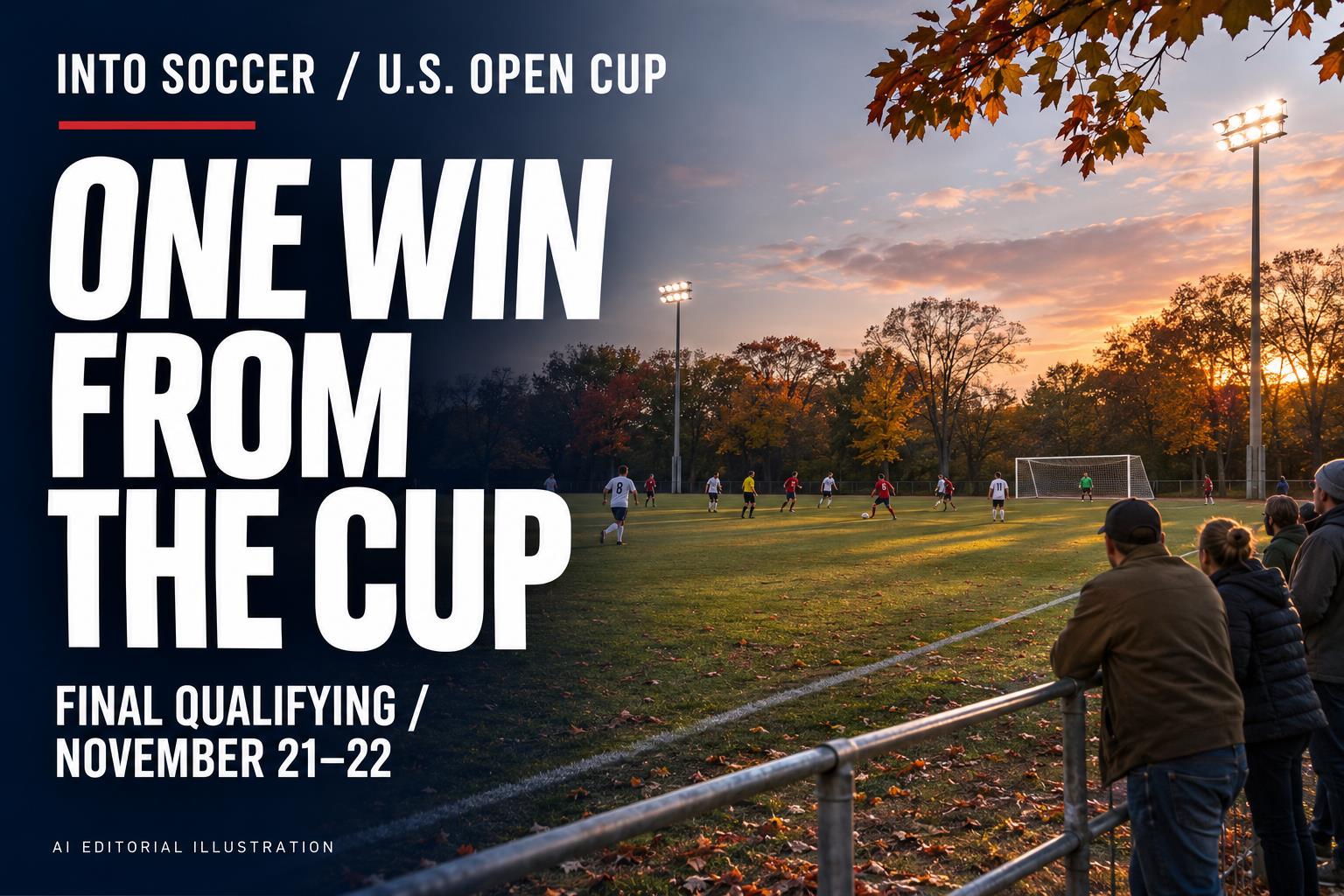
The 2027 U.S. Open Cup is already producing decisive games in 2026. U.S. Soccer’s November 5 update confirms that 32 teams remain in the qualifying route, with 16 places in the Tournament Proper at stake on November 21–22. The federation says those qualifiers will face professional clubs beginning in April 2027. For American fans who usually join the story when professional teams appear, this is the stage worth noticing now.
Cover: AI-generated illustration of a fictional local soccer ground, not a photograph of an Open Cup match.
Why there are two different groups of 32
The numbers are easy to confuse. U.S. Soccer’s July 9 Open Division announcement allocated 32 Tournament Proper places to that division: 16 through qualifying and 16 through direct entry based on selected competitions. The 32 teams still playing in November are competing for the qualifying half. They are not all already in the main tournament.

That distinction matters when comparing clubs’ routes. A direct-entry place and a win in final qualifying reach the same next stage through different mechanisms. Calling every amateur participant a qualifier erases that difference; assuming all 32 remaining teams will progress doubles the available places.
| Stage or route | Confirmed figure | What it means |
|---|---|---|
| Final qualifying, November 21–22 | 32 teams seeking 16 places | One remaining qualifying round. |
| Direct-entry Open Division route | 16 allocated places | Separate from the fall qualifying winners. |
| Open Division in Tournament Proper | 32 allocated places in total | The two routes combine here. |
The previous round shows what is at stake
The federation’s third-round recap provides two striking examples: Philadelphia Lone Star recovered from 3–0 down at halftime against WC Predators, drew 4–4 through extra time and won the shootout 4–3. Omaha Street also advanced after a 4–4 game, beating Milwaukee Bavarians 4–2 on penalties. These are reported results, not matches I attended.
The editorial lesson is not that every amateur cup tie becomes a classic. It is that the event’s meaning does not depend on a famous badge entering the draw. For the clubs still alive, the next game can change the scale of the following spring’s program. A supporter who learns the team now can follow that transition rather than discover it only as a professional opponent’s away fixture.
Follow a local club without guessing the logistics
Start with the federation’s qualifying coverage, then check the club’s own channels for its confirmed opponent, venue, kickoff and admission arrangements. A November 21–22 match window is not an individual game listing. Do not turn up at a regular league venue on the assumption the cup match will be there, or assume that a ticket or livestream is free.
For an out-of-state stream, check whether the kickoff is shown in the host’s local time or your own device’s time zone. For an in-person trip, confirm parking and any venue restrictions before leaving. This article does not establish a national television package, ticket price or a particular club’s final-round kickoff; use the published match information when planning.
A cup run is a different route from a league table
A knockout result can take a club further in a tournament without changing the league it plays in. Following a cup run and following promotion are different stories. For a new viewer, a useful first question is simply what a win advances the club into—not which division the opponent’s badge makes you imagine.
Our MLS playoff guide shows why counting wins depends on the competition format. Our NWSL quarterfinal guide covers a separate November knockout weekend. If the amateur side of the sport makes you want to play, our pickup-versus-league comparison is a starting point; casual participation and national cup eligibility are separate questions.
For this story, the next meaningful update is the final-round match schedule and then the 16 qualifiers. Until those results arrive, the honest headline is the opportunity: 32 teams, one more qualifying hurdle, and a place in the 2027 competition still to earn. Information checked November 6, 2026.
Leave a Reply